
Closed cell and open cell
Spray Foam Insulation in Holland, MI
Foam that insulates and air seals in one pass, sprayed only where it earns its price.
- Free on-site estimates in Holland and nearby towns
- Written quotes that name the foam, the depth and the R-value
- Roof leaks, wet sills and old wiring flagged before anything is covered
Insulation and Air Seal in One Layer
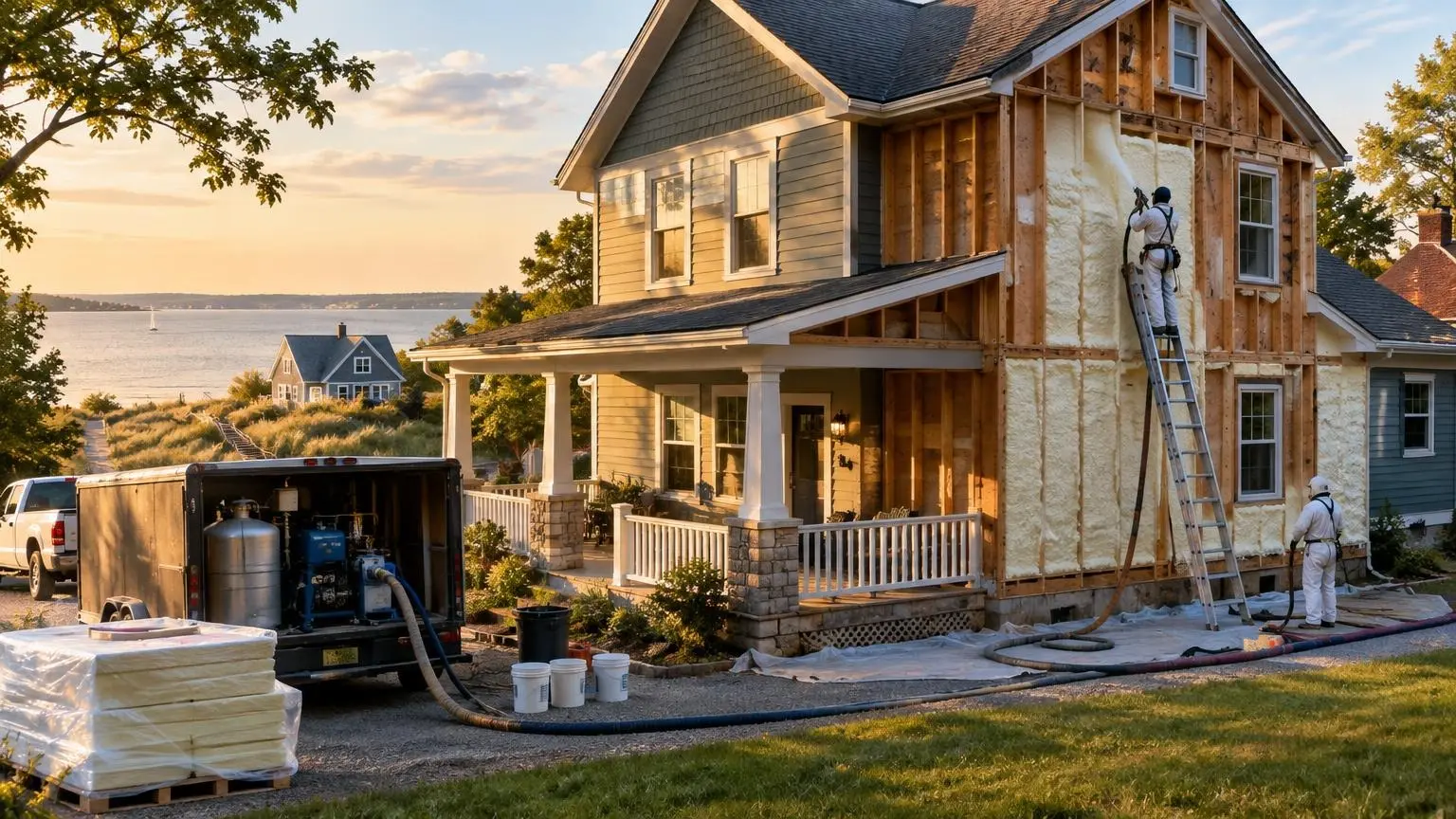
Spray Foam Insulation is a liquid that is sprayed onto framing, concrete or steel, expands, and cures into a solid layer that both insulates and blocks air. That second job is what sets it apart from batts and loose fill, which slow heat but let air move through them. In a Holland house, air leaks at the rim joist, the attic floor and the floor over a crawl space often cost more heat than thin insulation does, and foam closes those leaks while it insulates.
Closed-cell foam
Closed-cell foam cures hard and dense. HomeGuide rates it at about R-5 to R-7 per inch, so two or three inches gives real R-value in a tight space. At that thickness it slows water vapor and does not absorb water, which is why we use it on rim joists, foundation and crawl space walls, under floors over damp crawl spaces, on roof decks with no attic above, and on the steel of pole barns and shops. It also stiffens what it sticks to.
Open-cell foam
Open-cell foam is soft and spongy and rated around R-3.5 to R-3.8 per inch. It expands a lot, fills irregular cavities completely, and deadens sound, which makes it useful in interior walls, between floors and on attic rooflines when a house is being converted to a conditioned attic. Because it lets vapor pass, a Michigan wall or roof built with open cell needs a vapor plan on the warm side, and we do not put it against cold concrete or steel.
Where foam is the wrong choice
An open attic floor with room to work is usually cheaper to air seal and then blow full of cellulose or fiberglass than to foam. Walls that are already closed up with plaster or drywall are usually filled with dense-pack cellulose through small holes rather than opened for foam. Foam is also not a fix for water: a leaking roof, a wet foundation or a plumbing drip has to be repaired first, or the foam will hide the problem.
How a foam job goes
We measure each area and write down the foam type, thickness, R-value and price for it. On the day, we cover floors and belongings, set up ventilation, and spray in passes to the depth on the estimate. HomeGuide advises staying out for at least 24 hours while foam cures and airs out, so we plan the job around that. In living or storage space, foam usually needs a thermal or ignition barrier depending on the product and the use of the space, and we tell you up front if your job needs one.
Lakeshore homes and cottages
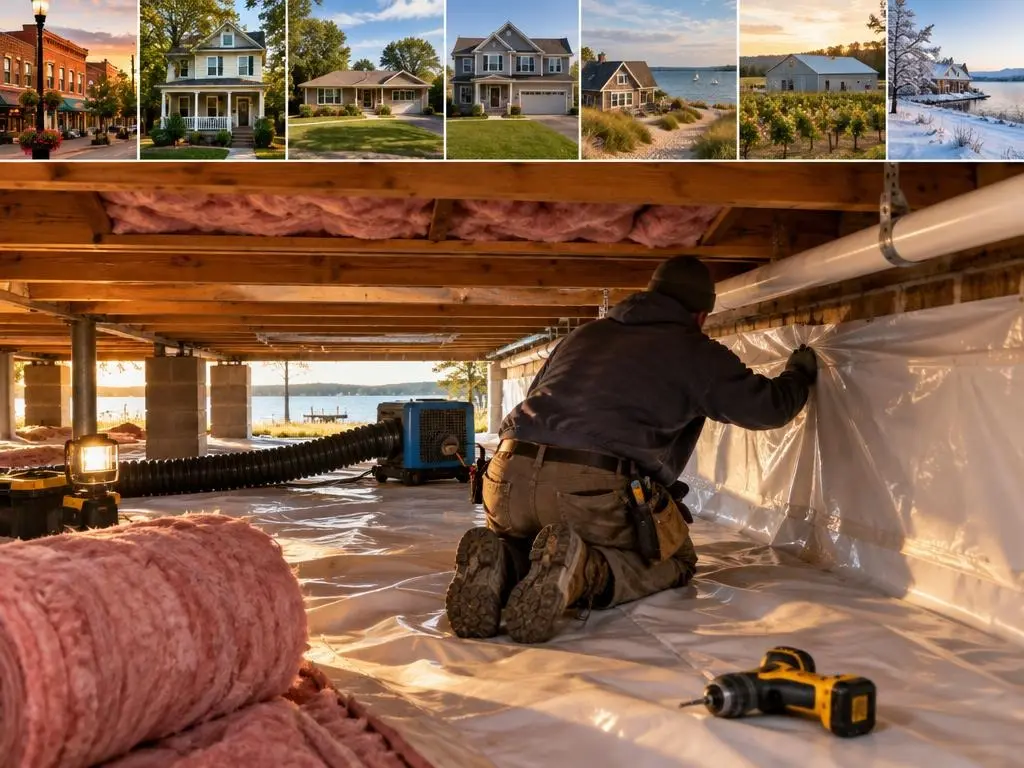
Cottages near Lake Macatawa and along the Lake Michigan shore often sit on crawl spaces or piers and were built for summer. When owners start using them in shoulder seasons or year-round, cold floors and frozen pipes follow. Closed-cell foam on the crawl space walls and rim, or under the floor where the crawl space stays open to the air, is often the most direct fix.
Call (616) 801-4092 or ask for an estimate and we will show you where foam makes sense in your house and where it does not. Get a free estimate
What This Covers
Where we spray foam and what it does there.
Rim joists and sill plates
Closed-cell sprayed on the band joist and sill to stop the drafts at the top of the foundation.
Attic rooflines
Open or closed cell under the roof deck to bring an attic, bonus room or cathedral ceiling inside the insulated shell.
Crawl space walls and floors
Closed-cell on block walls, or under the floor of a cottage that sits on piers.
Basement walls
Closed-cell on foundation walls before framing, so damp air never reaches cold concrete.
Additions and new framing
Open or closed cell in open stud walls during a build or remodel.
Pole barns, shops and garages
Closed-cell on steel or wood to insulate and stop condensation.
Published Spray Foam Insulation Costs
| Job | Range and source |
|---|---|
| Spray foam, installed | $1.50 to $5.00 per sq ft (HomeGuide) |
| Open-cell / closed-cell | $1.50 to $3.50 / $3.00 to $5.00 per sq ft (HomeGuide) |
| About 1,000 sq ft | $1,500 to $5,000 (HomeGuide); $3,150 to $7,500 existing home (Fixr) |
| Existing walls / new construction | $3.15 to $7.50 / $2.75 to $6.50 per sq ft (Fixr) |
| All exterior walls | $4,000 to $10,000 (HomeGuide) |
| Whole house | $8,000 to $20,000 (HomeGuide); $10,000 to $30,000 (Fixr) |
| Typical job minimum | $1,000 to $2,000+ (HomeGuide) |
National ranges from HomeGuide (2026) and Fixr (2025), shown so you know the ballpark. Foam type, depth, access, prep and minimum charges change the total for any one house. We measure, then hand you a written estimate, and that estimate is what you pay.
How It Works
1. Walk-through
We look at each space, measure it, and check for leaks, damp wood and wiring problems.
2. Written plan
You get a line for each area with foam type, thickness, R-value and price.
3. Prep and spray
We cover and mask, ventilate, and spray in passes to the specified depth.
4. Barrier and cleanup
Any needed thermal or ignition barrier goes on, trimmings are removed and we walk the work with you.

Why Choose Us for Spray Foam Insulation
Foam only where it pays
If sealing and blowing in does a space for less, we say so.
Thickness on paper
Depth and R-value are written for every area so you can compare.
Dry surfaces first
Leaks and wet framing are pointed out before we cover them.
Spray Foam Insulation Questions
What can spray foam have the highest R-value?
Closed-cell foam has the higher R-value per inch, about R-5 to R-7 in HomeGuide's figures, compared with roughly R-3.5 to R-3.8 for open cell. Total R-value depends on thickness, so we write the depth and resulting R-value on the estimate.
How long do we need to stay out of the house?
HomeGuide advises leaving for at least 24 hours while foam cures and the space is ventilated. For a cottage, we often schedule foam between visits so it has time to air out.
Does spray foam stop moisture?
Closed-cell foam at normal thickness slows water vapor and does not absorb water, so it keeps damp air off cold surfaces like rim joists and crawl space walls. It does not stop liquid water from a leak, which has to be fixed first.
Can you spray foam into finished walls?
Not in the usual way, because foam has to be sprayed into open cavities. For closed walls we normally fill with dense-pack cellulose through small holes, or open the wall if it is being remodeled anyway.

Spray Foam Insulation Service Areas
- Spray Foam Insulation in Holland, MI
- Spray Foam Insulation in Zeeland, MI
- Spray Foam Insulation in Holland Charter Township, MI
- Spray Foam Insulation in Park Township, MI
- Spray Foam Insulation in Laketown Township, MI
- Spray Foam Insulation in Saugatuck, MI
- Spray Foam Insulation in Douglas, MI
- Spray Foam Insulation in Fennville, MI
- Spray Foam Insulation in Grand Haven, MI
- Spray Foam Insulation in Spring Lake, MI
- Spray Foam Insulation in Hudsonville, MI
- Spray Foam Insulation in Jenison, MI
- Spray Foam Insulation in Allendale, MI
Get a Spray Foam Insulation Estimate
Free spray foam estimates in Holland and nearby towns.